Showing posts with label ICC. Show all posts
By Erika Suhr

Picture: Globe License: Public Domain

A Rocky Start

At the start of 2017, the International Criminal Court (ICC) seemed to be experiencing an existential moment. Russia had withdrawn itself from the process of ratifying the Rome Statute internally in protest of the ICC’s ruling that Russia’s 2014 takeover of the Crimea peninsula had been an armed conflict between it and Ukraine, making the annexation fall under the court’s jurisdiction. In January, a non-binding African Union resolution called for its members to withdraw en masse from the ICC, with some countries arguing that the ICC, beyond subverting their sovereignty, disproportionately targets African countries. The African Union supports instead, a regionalization of international law, where there would be a war crimes court, specifically devoted to Africa. Opponents worry about the independence of such a court, and that the risk of violations of war crimes in African states would rise as a result. The Foreign Minister of Nigeria noted the vital role that the ICC plays in holding leaders accountable, and stated that Senegal, Cape Verde, and other countries would speak out against the resolution to withdraw.

Burundi Withdrawal

Burundi, The Gambia, and South Africa all decided to withdraw from the ICC, but ultimately, only Burundi carried out its threat. The Gambia, under new leadership, announced its reversal of the decision to withdraw on state television, citing its “commitment to the principles enshrined in the Rome Statue of the International Criminal Court”. South Africa also revoked its decision to withdraw from the ICC, citing a recent court ruling that declared the withdrawal “unconstitutional and invalid.”
On October 27, 2017 Burundi, a year after declaring its intentions, became the first country to withdraw from the International Criminal Court.  The timing of Burundi’s withdrawal coincides with a report released by the United Nations Commission of Inquiry. The report recommended that a criminal investigation on crimes committed in Burundi be initiated in response to evidence of torture, sexual violence, extrajudicial killings, disappearances, and illegitimate arrests and detentions sponsored by the regime of Burundi’s president, Pierre Nkurunziza.

A Reinvigorated Court

Perhaps as a response to the criticism of the African Union and others, the ICC’s prosecutor has publicized a shift away from Africa towards other regions. She announced that she is opening preliminary investigations into crimes perpetuated in the Philippines, Afghanistan, and Venezuela. The Philippines probe will focus on allegations reaching back to July of 2016, relating to the government’s war on drugs, which has since killed thousands of people, many under dubious circumstances and justifications. The Venezuelan probe will likewise focus on government and police forces, in that case, that the government forces “frequently used excessive force to disperse and put down demonstrations,” and tortured and abused members of the opposition who were unlawfully detained by the government, indefinitely.

Most controversially, the prosecutor called upon the court to open an investigation into war crimes and crimes against humanity in Afghanistan. The scope of that investigation could encompass U.S. troops. No specific parties or events have been named, but a report released by the prosecutor’s office says that there is a reasonable basis to believe that the following crimes have been committed:
  • "Crimes against humanity and war crimes by the Taliban and their affiliated Haqqani Network;
  • "War crimes of torture and related ill-treatment by Afghan government forces, in particular the intelligence agency (National Directorate for Security), and the Afghan National Police;
  • "War crimes of torture and related ill-treatment, by US military forces deployed to Afghanistan and in secret detention facilities operated by the Central Intelligence Agency, principally in the 2003-2004 period, although allegedly continuing in some cases until 2014."
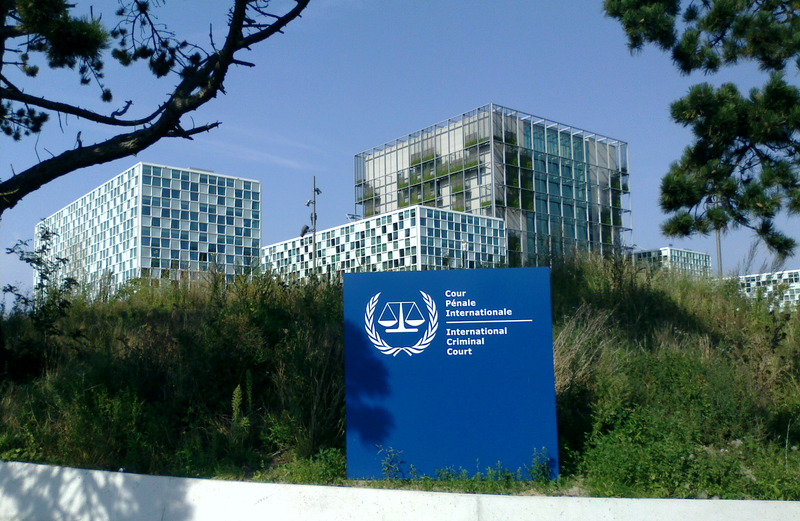


By Erika V. Suhr

File:International Criminal Court building (2016) in The Hague.png
Image: ICC Building License: CC BY-SA 4.0


On October 27, 2017 Burundi, a year after declaring its intentions, became the first country to withdraw from the International Criminal Court.  The timing of Burundi’s withdrawal coincides with a report released by the United Nations Commission of Inquiry. The report recommended that a criminal investigation on crimes committed in Burundi be initiated in response to evidence of torture, sexual violence, extrajudicial killings, disappearances, and illegitimate arrests and detentions sponsored by the regime of Burundi’s president, Pierre Nkurunziza.

At the time that Burundi announced its decision to withdraw from the Rome Statute, it seemed like it could be the leader in a wave of withdrawals by other African nations. Many nations in Africa have criticized the ICC as being a tool for post-colonial control of African nations and a proxy for Western-led regime change. The ICC came under fire around the time it chose not to pursue charges against William Ruto and Uhuru Kenyatta, Kenya’s deputy president and president, who were both accused of violence surrounding Kenya’s 2007 election, which resulted in over 1,100 deaths and disappearances. However, South Africa rescinded on its threat in March of last year after its High Court ruled that Parliamentary approval was required to carry out the measure. Gambia also backed down after a presidential election defeated the 22-year incumbent. These political events forestalled a potential exodus from the ICC by prominent African members.

Burundi’s exit is an illustration of what can perhaps be expected when the Court attacks sitting officials instead of the fringe rebel groups it has in the past. However, it might be a symptom of an underlying fatal problem. At the very least, it presents an opportunity to reflect on the future of the ICC, and how it will respond to its critics going forward.

For instance, the criticism cited by Burundi and other African countries is that Africa is unfairly targeted while other world conflicts, especially those in which Western countries are involved in, are ignored. The ICC’s record seems to support that notion to some extent. Presently, nine out of the ten formal investigations conducted by the ICC are Africa-related, and all of its trials have been against African defendants. Additionally, the glaring absence of three of the five Security Council powers from the Rome Statute (the United States, Russia, and China) rankles member states who see the ICC as a political instrument wielded against the Global South. A rebuttal to this criticism might be that of the nine African countries being investigated by the ICC, five have been referred to the Court by their own governments. In only two cases has the ICC’s prosecutor used her discretion to bring a case. Further, a look at the list of countries that are being examined by the ICC reveals a less Africa-centric perspective. Countries under “preliminary examinations” include Afghanistan, Burundi, Colombia, Gabon, Guinea, Iraq/UK, Nigeria, Palestine, Registered Vessels of Comoros, Greece, Cambodia, and Ukraine.

Second, the argument exists that the Court is wildly inefficient. Since it began functioning in 2002, judges have issued only 31 arrest warrants. 25 cases have been heard before the Court and of those cases verdicts have been issued in six of them. Ultimately, nine people have been convicted and one was acquitted. Those results have cost over $1 billion since the Court’s inception, and today the ICC has an operating cost of $145 million per year. However, one might concede that investigations surrounding the gravest human rights violations are complex and time-consuming, as evinced by ad-hoc tribunals of isolated conflicts, such as the International Tribunal for the Former Yugoslavia. This is especially so when there is no cooperation from the country in which one is investigating.

There are tensions over the Court’s willingness in the coming years to test nonmember states and regions that it has historically not pursued. For instance, in its preliminary examination of Afghanistan, will it encompass United States actors in its inquest, or even Afghan state actors, or will it choose to go after dissident groups, like the Taliban, and count on some international cooperation? Russia has already blocked two Security Council resolutions to refer the Syrian crisis to investigation by the ICC. In face of this opposition, how aggressively will the ICC pursue allies of the Russian government, or the Russian government itself? Will it target the most culpable individuals?
Notwithstanding the criticisms and the setback of Burundi’s exit, one can say that some justice is preferable to no justice and that every incremental step forward in prosecuting human rights offenses is a victory and a testament to the better angels of our humanity.

As for Burundi, it is possible that it has not escaped the Court, despite its best efforts. Under the Rome Statute, crimes in nonmember states can still be referred to the Court for investigation by the UN Security Council. In this case, the commission did recommend a referral. The Court has stated that it would still claim jurisdiction over Burundi, but it might be difficult for them to do so. The status of Burundi’s case is a preliminary examination. For it to rise to an investigation, the ICC’s judges would have to grant the request of the Court’s prosecutor, and Burundi will most likely argue that there is no legal basis for them to do so now it is no longer a party. 
By Jack Mitchell*


The Temple of Bel, Palmyra, was destroyed in 2015 by the Islamic State.Photo: Wikimedia Commons/Bernard Gagnon

I
In 2012, at the UNESCO World Heritage site in Timbuktu, Mali, Ahmad Al Faqi Al Mahdi destroyed historic mausoleums, manuscripts, and even a mosque. Al Mahdi belonged to the Al-Qaeda-linked group, Ansar Dine. His subsequent conviction by the International Criminal Court (ICC) last year was covered in the mainstream press and art world publications as a “landmark” case, the first time the destruction of “cultural heritage” was prosecuted as a war crime in the ICC. In prosecuting and convicting Al Mahdi, however, the ICC did not create a new war crime for destroying “cultural heritage.” Rather, it invoked part of Article 8 of the Rome Statute that it had never used before. Under Article 8(2)(e)(iv) of the Rome Statute, intentionally “directing attacks against buildings dedicated to religion, education, art, science or charitable purposes, historic monuments, hospitals and places where the sick are wounded and collected, provided they are not military objectives” is a war crime.

The Al Mahdi case was so lurid because it fit a grisly pattern of World Heritage and other significant cultural sites targeted by Islamist extremists, including the Islamic State of Iraq and the Levant (ISIL). ISIL has destroyed numerous historic sites in Syria and Iraq, including ancient Assyrian sites. When it obliterated the Temple of Bel and other ancient features in Palmyra in 2015, for example, the loss was as devastating as the 2001 Taliban bombing in Afghanistan of the Buddhas of Bamiyan.  So far, though, Al Mahdi’s conviction remains a significant but isolated precedent.  The destruction of the Bamiyan Buddhas was never subject to prosecution in the ICC because the Rome Statute had not yet entered into force.  The perpetrators of cultural heritage destruction in Syria also might elude prosecution in the ICC because Syria, like the United States, is not a party to the ICC, meaning that an ICC investigation and prosecution would require an unlikely referral from the UN Security Council.

But it’s not just terrorist groups. States and non-state actors have participated in recent cultural heritage destruction. According to Matthew Barber, former director of Yazda, ISIL’s campaign to exterminate the Yazidis went forward because KDP forces decided not to defend them. Similarly, the US has been mute as its ally Saudi Arabia bombs the UNESCO-listed Old City of Sana’a in Yemen.

II
First, principles about the law of cultural heritage are surprisingly unsettled. What is the difference between “cultural heritage” and the older term, “cultural property?” If cultural heritage is the more encompassing concept, what should its boundaries be? Second, how do we assess the gravity of cultural heritage destruction?
International criminal law would do well to focus on cultural property destruction as a war crime—as opposed to language and oral history, for example—because deeper efforts at “cultural cleansing” would possibly fit better under the umbrella of crimes against humanity.

Two key factors concerning when cultural property destruction should be prosecuted are military necessity and gravity of the crime. Military necessity, although the doctrine is controversial, is a kind of “affirmative defense” to cultural property destruction because an opponent’s use of cultural property or its status as a military objective can be used as justification for its destruction. This doctrine has sparked promising efforts to improve militaries’ awareness about where cultural property is located such as ICOM’s Red List and archeological inventories used to create “no-strike lists.”


The gravity of the crime question depends upon our purpose. Should cultural heritage law protect people or things? A “people” approach emphasizes what cultural property means to distinct groups of people. A “things” approach emphasizes its supposed intrinsic worth. Both approaches are flawed. The first might have to credit nationalistic myths. The second might entail using market value or the fallible judgment of UNESCO as a proxy for actual value. My trite but sincere belief is that international criminal law can adopt a flexible standard that recognizes that gravity is established for targeted, damaged, or destroyed cultural property both when it is especially meaningful to specific cultures and when it has internationally recognized importance.

*Jack Mitchell is a student at Georgetown University Law Center in the class of 2019. This blog post is the winner of the International Cultural Heritage Law Blog Post Competition that was co-sponsored by the American Society of International Law, the Georgetown Journal of International Law, the Lawyers’ Committee for Cultural Heritage Preservation, and the Georgetown Art Law Association.
By Navy Thompson


In a year marked by major shifts in the international political and legal communities, many may have missed important developments in the growing area of cultural heritage law. These changes have occurred in both national and international arenas, and may have a broad range of potential consequences.

On September 27, 2016 the International Criminal Court’s Trial Chamber VIII found Ahmad Al Faqi Al Mahdi guilty of the war crime of “intentionally directing attacks against religious and historic buildings.” The buildings in question were ten religious shrines in Timbuktu, Mali, which were destroyed between June and July of 2012, in the context of a domestic armed conflict in the country. Al-Mahdi, viewed as “an expert on religious matters,” allegedly worked with groups known as Ansar Dine and AQIM, which took over Timbuktu after the Malian military retreated from the area. During the occupation, Al-Mahdi ordered the destruction of the sacred buildings and mausoleums, none of which held military significance. Nearly all of the sites had also been named UNESCO World Heritage Sites, such that the court found their destruction to cause injury to the international community in addition to those directly affected in Mali. Al-Mahdi personally helped to destroy five of the sites, and the ten attacks constituted war crimes according to the provisions of the Rome Statute. He eventually confessed and apologized for his role in the crimes in order to receive a shorter sentence of nine years.

The decision has been hailed as a great step toward effectively holding destroyers of cultural and religious property accountable in international law. Most significantly, the case marks the first time in history that the ICC has tried a war crimes case based solely on destruction of cultural heritage charges.
                                                                  
Several countries enacted their own diverse cultural heritage protection laws in 2016.
Also of note, Art Recovery International launched Artive, the world’s first non-profit focused on identifying claims on works of art and on consolidating information regarding stolen, destroyed, or looted cultural property and art pieces. The project will function as a database platform for the preservation of cultural heritage property. Its creation may play a significant role in the future of cultural heritage protection as it creates a network through which information regarding such issues and claims can be shared and circulated worldwide.