Showing posts with label Yemen. Show all posts
By Maura Sokol 


Prime Minister Ahmed bin Dagher has accused southern separatists in Yemen of attempting a coup after fighting began in the country’s southern port city, Aden. The separatists are known as the Southern Transitional Council (STC). The STC is led by Aidarous al-Zubaydi, the former governor of Aden who was forced out of his position by President Abed Rabbo Mansour Hadi. Fighting first broke out on Sunday, January 28th, when a deadline expired that the separatists had issued demanding the resignation of the government. The separatists seek independence for the southern part of Yemen, which was previously a separate country before a unification with the northern part of Yemen in 1990. The Southern Transitional Council has now demanded the removal of the Prime Minister and accused the government of corruption. In just a few days, the council has seized control of most of Aden and surrounded the Presidential Palace, which contains members of President Hadi’s government. The President himself is based in Riyadh.  

The conflict between President Hadi’s government and the separatists calls into question the stability of a coalition that has been fighting on the same side of the Yemeni Civil War since 2015. Hadi’s government is backed by Saudi Arabia, which leads a coalition of nine other countries in a military intervention against the Houthi movement. The civil war began when the Houthi movement, which supports Yemen’s Shia Muslim minority, rebelled against the government. The Houthis now control Yemen’s capital, Sanaa, and much of northern Yemen. Although the Saudi-led coalition has been fighting in support of Hadi’s government for the past three years, the United Arab Emirates is a key member of the coalition and supports the southern separatists. The separatists are financed and armed by the UAE, while Saudi Arabia supports Hadi’s government. Al-Zubaydi has made public comments since the fighting began declaring that the separatists remain committed to the coalition and to driving the Houthis out of Sanaa.

President Hadi’s government and the UAE have been in conflict for most of the existence of the coalition. The UAE has taken advantage of the situation to secure control over oil and gas ports in southern Yemen, and President Hadi has publicly accused the UAE of acting as an occupier in Yemen. President Hadi is also allied with the Islah Party, a branch of the Muslim Brotherhood and a known enemy of the UAE. 

As of Wednesday, the International Red Cross reported at least 36 killed and 185 wounded in this week’s fighting. The larger Yemen crisis has been declared the world’s worst man-made humanitarian disaster by the United Nations. According to the UN Human Rights Council, over half of the people who have been killed in the conflict are civilians, and civilians are the victims of repeated and “unrelenting violations of international humanitarian law.” Air strikes from the Saudi-led coalition are the leading cause of overall civilian casualties. Currently about 22.2 million people, or about 75% of Yemen’s population, are in need of humanitarian assistance.
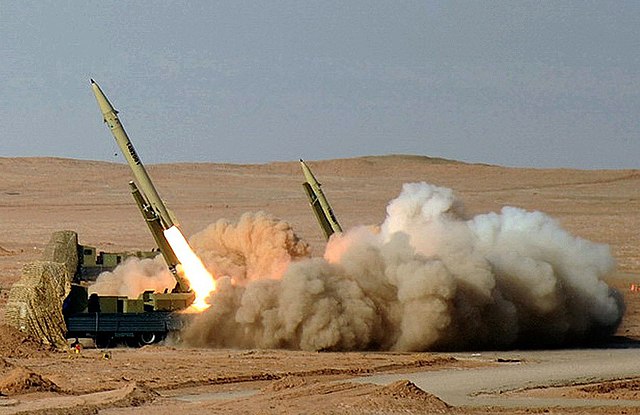

By Navy Binning

Photo: Great Prophet VII Maneuvers Iran, Creative Common License

Earlier this month, Saudi Arabia charged Iran with an “act of war”.

Saudi Arabia and Iran have been engaged in suppressed aggression and hostility for decades. After Yemen rebels known as Houthis overthrew the government in 2015, Saudi forces began an attack against the Houthi forces to restore the internationally recognized government. Yemen has since been caught in the midst of conflict that has killed over ten thousand civilians. Saudi air strikes have been the leading cause of civilian casualties. Iran has openly expressed its support for the Houthi, but it has never claimed to provide resources or to lead the rebel group.

On November 4th, a missile was fired from Yemen towards Riyadh, the capital of Saudi Arabia, and intercepted over the city’s airport. The Houthi claim the missile attack was retaliation for a Saudi attack that killed twenty-six people. Saudi Arabia and the United States have since accused Iran of providing missiles to Yemen rebels, one of which was used in the attack on Riyadh. Although Saudi Arabia and the United States have previously accused Iran of supporting the Houthis, there has never been direct proof of the allegation.  

Saudi Arabia’s declaration that Iran has engaged in an act of war is a bold one and a particularly foreboding one, following the years of hostility between the two nations. This begs the question —When does an act of aggression amount to an “act of war”?

The US Code defines “act of war” as “any act occurring in the course of (a) declared war; (b) armed conflict, whether or not war has been declared, between two or more nations; or (c) armed conflict between military forces of any origin”.

War can only occur between states. A conflict between a state and a non-state actor, such as a rebel group or terrorist organization, cannot constitute war. The exception is when the non-state actor is sponsored by a state. Saudi Arabia will need to prove that the Houthis were sponsored by Iran in order to properly allege that the missile attack was an act of war by Iran.

The United Nations Charter does not address “act of war”, but it does address the use of force. Article 2(4) requires members to refrain from “the threat or use of force against the territorial integrity or political independence of any state”. The missile attack clearly constitutes a use of force; however, Saudi Arabia must still show that it was a use of force by a member state.

There is no settled definition for “act of war”. The term has evolved to become more political than legal, with many believing that an “act of war” is simply any act that a state uses to justify a declaration of war.
In a statement responding to the attack, Saudi Arabia asserted that “the Kingdom reserves its right to respond to Iran in the appropriate time and manner”. What Saudi Arabia considers to be an appropriate response remains to be seen. 
By Jack Mitchell*


The Temple of Bel, Palmyra, was destroyed in 2015 by the Islamic State.Photo: Wikimedia Commons/Bernard Gagnon

I
In 2012, at the UNESCO World Heritage site in Timbuktu, Mali, Ahmad Al Faqi Al Mahdi destroyed historic mausoleums, manuscripts, and even a mosque. Al Mahdi belonged to the Al-Qaeda-linked group, Ansar Dine. His subsequent conviction by the International Criminal Court (ICC) last year was covered in the mainstream press and art world publications as a “landmark” case, the first time the destruction of “cultural heritage” was prosecuted as a war crime in the ICC. In prosecuting and convicting Al Mahdi, however, the ICC did not create a new war crime for destroying “cultural heritage.” Rather, it invoked part of Article 8 of the Rome Statute that it had never used before. Under Article 8(2)(e)(iv) of the Rome Statute, intentionally “directing attacks against buildings dedicated to religion, education, art, science or charitable purposes, historic monuments, hospitals and places where the sick are wounded and collected, provided they are not military objectives” is a war crime.

The Al Mahdi case was so lurid because it fit a grisly pattern of World Heritage and other significant cultural sites targeted by Islamist extremists, including the Islamic State of Iraq and the Levant (ISIL). ISIL has destroyed numerous historic sites in Syria and Iraq, including ancient Assyrian sites. When it obliterated the Temple of Bel and other ancient features in Palmyra in 2015, for example, the loss was as devastating as the 2001 Taliban bombing in Afghanistan of the Buddhas of Bamiyan.  So far, though, Al Mahdi’s conviction remains a significant but isolated precedent.  The destruction of the Bamiyan Buddhas was never subject to prosecution in the ICC because the Rome Statute had not yet entered into force.  The perpetrators of cultural heritage destruction in Syria also might elude prosecution in the ICC because Syria, like the United States, is not a party to the ICC, meaning that an ICC investigation and prosecution would require an unlikely referral from the UN Security Council.

But it’s not just terrorist groups. States and non-state actors have participated in recent cultural heritage destruction. According to Matthew Barber, former director of Yazda, ISIL’s campaign to exterminate the Yazidis went forward because KDP forces decided not to defend them. Similarly, the US has been mute as its ally Saudi Arabia bombs the UNESCO-listed Old City of Sana’a in Yemen.

II
First, principles about the law of cultural heritage are surprisingly unsettled. What is the difference between “cultural heritage” and the older term, “cultural property?” If cultural heritage is the more encompassing concept, what should its boundaries be? Second, how do we assess the gravity of cultural heritage destruction?
International criminal law would do well to focus on cultural property destruction as a war crime—as opposed to language and oral history, for example—because deeper efforts at “cultural cleansing” would possibly fit better under the umbrella of crimes against humanity.

Two key factors concerning when cultural property destruction should be prosecuted are military necessity and gravity of the crime. Military necessity, although the doctrine is controversial, is a kind of “affirmative defense” to cultural property destruction because an opponent’s use of cultural property or its status as a military objective can be used as justification for its destruction. This doctrine has sparked promising efforts to improve militaries’ awareness about where cultural property is located such as ICOM’s Red List and archeological inventories used to create “no-strike lists.”


The gravity of the crime question depends upon our purpose. Should cultural heritage law protect people or things? A “people” approach emphasizes what cultural property means to distinct groups of people. A “things” approach emphasizes its supposed intrinsic worth. Both approaches are flawed. The first might have to credit nationalistic myths. The second might entail using market value or the fallible judgment of UNESCO as a proxy for actual value. My trite but sincere belief is that international criminal law can adopt a flexible standard that recognizes that gravity is established for targeted, damaged, or destroyed cultural property both when it is especially meaningful to specific cultures and when it has internationally recognized importance.

*Jack Mitchell is a student at Georgetown University Law Center in the class of 2019. This blog post is the winner of the International Cultural Heritage Law Blog Post Competition that was co-sponsored by the American Society of International Law, the Georgetown Journal of International Law, the Lawyers’ Committee for Cultural Heritage Preservation, and the Georgetown Art Law Association.
By Sarah Akbar

A United Nations mission to report on human rights abuses during the civil war in Yemen could become a reality after Dutch diplomats called for the U.N. to take action. The Netherlands submitted a U.N. resolution last Thursday urging the office of the High Commissioner for Human Rights to “provide technical assistance” to the Yemeni government. This resolution could also make way for an authorization of a fact-finding mission that could shed more light on possible abuses. The Dutch resolution comes in the wake of a competing Saudi resolution submitted on Monday, urging the U.N. not to take action in the region. The two resolutions place the Unites States in a precarious position between two allies. Despite voicing its support for the Saudi-led coalition in the past, the United States has yet to make its opinion known on the subject.

By Sarah Akbar

Airstrikes by a Saudi-led coalition destroyed a military encampment belonging to Houthi rebels in the Yemeni capital of Sanaa early Sunday morning, intensifying the hostilities in the region. The airstrike was supposedly in retaliation for the bombing of dozens of coalition soldiers by the Houthis in the coalition-controlled central Marib province. Yemen has been embroiled in civil unrest, with the Houthis allying with former President Ali Abdullah Saleh and the coalition backing current President Rabbo Mansour Hadi (who was originally installed by a Gulf-Arab deal that ousted former President Saleh in 2012). The struggle for control of Yemen began in March of 2015 and has only intensified among international calls for a ceasefire and pleas for aid in the ensuing humanitarian crisis. The escalation of fighting this past weekend bodes ill for both of these appeals.
By Megan Abbot

Civilians are being killed in Yemen, possibly as part of a targeted campaign in violation of international law.  In the conflict that has killed over 4,500 people, the U.S.-backed coalition led by Saudi Arabia supports Yemen’s president-in-exile, Abd Rabu Mansour Hadi, against the predominantly Shiite Houthi fighters from the northern provinces.  Iona Craig reports for Intercept that while it’s unclear whether the bombings are intentionally targeting civilians—which would be a flagrant violation of international humanitarian law—airstrikes show a pattern of indiscriminate bombing in densely-populated areas, including “double-tap” strikes seeming to target civilians assisting in recovery.  Human rights groups have called for the UNHRC to investigate these alleged violations of international law, including U.S. involvement in the killings.