Showing posts with label immigration. Show all posts
By Anna Jarman

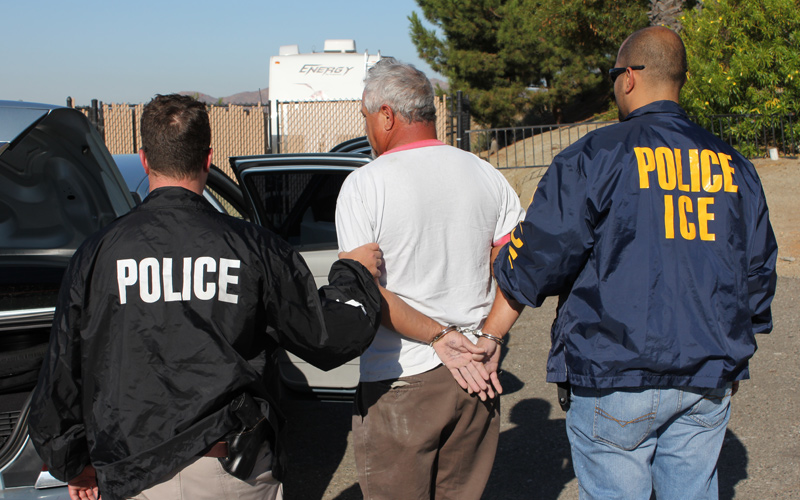
File:ICE.XCheckII.arrest.jpg


On September 25, 2017, Georgetown University Law Center hosted the 14th Annual Immigration Law and Policy Conference in partnership with the Migration Policy Institute (MPI) and Catholic Legal Immigration Network, Inc.  The conference addressed immigration policy changes under the Trump administration, including the crack-down on “sanctuary cities.” 

Muzzafar Chishti, director of MPI’s office in New York, moderated a discussion on sanctuary cities and local law enforcement’s role in immigration with Hiroshi Motomura, a law professor at the University of California, Los Angeles, School of Law; Daron Hall, the Sheriff of Davidson County, Tennessee; and J. Thomas Manger, the Chief of Police of Montgomery County, Maryland.

The Executive Order

Five days after taking office, President Trump issued an executive order blocking federal funding to “sanctuary cities” -- municipalities which restrict cooperation between local law enforcement and federal immigration agents.

President Trump’s stance on sanctuary cities fits neatly inside his “America First” foreign policy, which he campaigned on and which has guided his administration since he took office.  President Trump promised that he would put American workers first in all aspects of policy, whether that was negotiating favorable trade agreements or ensuring that illegal immigrants did not deprive American citizens of jobs, drain government benefits, or threaten public safety.

Many lawmakers, including President Trump, believe sanctuary cities threaten public safety by allowing criminals who could have been deported to go free and commit future crimes.  Local law enforcement officials counter that sanctuary measures are necessary to promote trust between illegal immigrants and police.

Sanctuary Cities: Testing Issues of Federalism

Motomura said this standoff over sanctuary cities between federal law and local officials is “testing issues of federalism.”  Immigration was, until recently, a federal issue.  However, the 1996 Illegal Immigration Reform and Immigrant Responsibility Act began to involve state and local governments in immigration enforcement, particularly through section 287(g) of the Act, which deputizes local law enforcement personnel to enforce federal immigration law. 

Some state and local governments have also passed laws on immigration.  For instance, Arizona passed S.B. 1070 which made immigration offenses state crimes and empowered the police to make warrantless arrests of aliens.  In Arizona v. United States, the Supreme Court held these provisions of S.B. 1070 preempted by federal law. 

Motomura explained that while Arizona reduced local governments’ power in immigration enforcement, it did not address the 10th Amendment issues of coercion and deputizing local police that sanctuary cities implicate.  The Supreme Court has previously held in Printz v. United States that the federal government may not order local officials to enforce federal law.  Additionally, National Federation of Independent Business v. Sebelius, concerning the Affordable Care Act, held that the government cannot use the threat of large funding cuts to “coerce” states into adopting federally demanded policies.  Given the importance of these issues, Motomura expects the federal government to weigh in on these issues as they continue to pressure sanctuary cities.

Practical Issues of Enforcement: Local Law Enforcement’s Perspective

The lack of clarity surrounding law enforcement’s role in immigration enforcement presents a great challenge to local law enforcement agencies, which find themselves embroiled in a divisive political issue and faced with difficult decisions about how best to police their communities.

Sheriff Hall does not think immigration should be something he should be doing, but “since the federal government doesn’t do a good job, [he has] to step in.”  Under his leadership, Davidson County eventually left the controversial 287(g) program.  The program that replaced it, Secure Communities, does not deputize local police but instead requires participating jails to submit arrestee’s fingerprints to the U.S. Immigration and Customs Enforcement’s (ICE) immigration database.  The problem with this approach, Sheriff Hall said, is that an arrestee’s fingerprints will be identifiable only if he has already had an encounter with ICE.  This means that an undocumented immigrant could have committed twenty crimes but remain unknown to ICE.


For both Sheriff Hall and Chief Manger, the challenge is finding a balance between public safety and limiting the harmful effects of deportations on individuals and the community.  Chief Manger worries about the danger created when a portion of the population fears the police and won’t come forward to report crimes or act as witnesses.  In its attempt to strike the right balance, Montgomery County does not comply when ICE asks the county jail to detain an illegal immigrant until they can be taken into ICE custody, but does respond when ICE inquires about individuals held in the county jail.  

By Jordan Federer


The Numbers
After 2015, a year in which over one million refugees and migrants traveled to the EU, 362,376 people arrived in 2016 by crossing the Mediterranean Sea. Of the 362,376 refugees and migrants that arrived by sea in 2016, 48% entered through Greece (Eastern Mediterranean Route), 50% through Italy (Central Mediterranean Route), and 2% through Spain (Western Mediterranean Route). Once migrants and asylum-seekers entered the EU through Greece, they tried to continue their journey towards Western Europe vis-à-vis the Western Balkan Route (through Macedonia, Serbia, Hungary, and Croatia). Syrians, Iraqis and Afghanis were the predominant nationalities of those that made use of the Western Balkan Route. Overall, refugees and migrants traveled out of the following countries: Syria (23%), Afghanistan (12%), Nigeria (10%), Iraq (8%), Eritrea (6%), Guinea (4%), Côte d’Ivoire (4%), The Gambia (4%), Pakistan (3%), and Senegal (3%). In 2016, approximately 1,195,265 asylum applications were filed and the top five nationalities of asylum applications were Syria, Afghanistan, Iraq, Pakistan, and Iran. The top five destination countries for asylum seekers were Germany, Italy, France, Greece, and the UK. Approximately 56% of first instance asylum applications received a positive decision. The United Nations High Commissioner for Refugees (UNHCR) Accommodation/Relocation Program currently provides those whose applications either have not yet been reviewed or those who have received a negative decision with temporary places to stay either in “apartments, hotel buildings, host families and relocation sites with services,” which serve as alternatives to camps.

Events
In February and March of 2016, Macedonia closed its border along the northern part of Greece. The move by Macedonia was “part of a chain reaction” of border restrictions in both Slovenia and Serbia. This coordinated effort resulted in the closure of the Western Balkan Route, stranding thousands of migrants, mostly Syrian and Iraqi migrants, on the Greek side of the border. In the same month, the EU and Turkey executed a deal (The “EU-Turkey Statement”), in which “Ankara would take back all illegal migrants who cross to Greece, including Syrians, in return for the EU taking in thousands of Syrian refugees directly from Turkey and rewarding it with more money, early visa-free travel and progress in its EU membership negotiations.” The UNHCR argues that the EU-Turkey Statement’s commitment to pushing refugees back into Turkey and Syria where they face persecution is a violation of the European Convention of Human Rights. Additionally, as a result of the Balkan border closures and the implementation of the EU-Turkey Statement, migrant camps across Greece were turned into quasi-detention centers. Thousands of people fleeing war torn countries such as Syria and Iraq found themselves at the mercy of the Greek government and the EU-Turkey Statement’s directive. Organizations such as Amnesty International, Human Rights Watch, and Doctors Without Borders have publicly criticized the Greek government’s treatment of detained refugees and the conditions as “inhumane” and “fetid.”
By Victoria Hines

A discussion paper released by the Centre for Economic Performance suggests that “immigrants promote exports of final services, both overall and particularly to their countries of origin.” Moreover, the effects appear to be even stronger when trading partners share cultural and institutional similarities. A potential explanation for this finding is that immigrants reduce exporting or importing costs of services by helping their home country overcome cultural and institutional barriers with foreign markets. Not only are trade costs reduced, but immigrants can also increase productivity by contributing their specialization and creativity.
By Jeff Najjar

Peter Sutherland—the UN’s special representative for migration—has called for a global response to the growing migration crisis in Europe.  The rights of migrant populations has become one of the most significant humanitarian issues around the world, as millions seek asylum from conflict nations.  Sutherland’s statements follow earlier comments from UN Secretary-General Ban Ki-moon, who urged the global community to develop comprehensive solutions to allow for safe and legal migration.  The International Organization for Migration reported that more than 2,000 migrants have died this year in an attempt to enter Europe through the Mediterranean Sea.
By Jeff Najjar

Antonio Guterres—the UN high commissioner for refugees—has called on the European Union (EU) to admit up to 200,000 refugees as part of a mass relocation program that would be binding on EU states. EU foreign ministers are due to meet on Friday to discuss the continent’s rising refugee crisis. Guterres’s appeal, echoed by France and Germany, recommends establishing EU quotas to share the burden of an increase of migrants and refugees, which has significantly impacted Greece, Italy and several countries in southeastern and central Europe. Guterres’s call for the EU to admit refugees has several opponents who are concerned about protecting their respective borders amidst the flow of migrants and refugees into the EU.
By Kristen E. McCannon

U.S. Immigration and Customs Enforcement moved to deport General Carlos Eugenio Vides Casanova of El Salvador last week. The deportation is fueled by allegations that General Casanova participated in human rights abuses in El Salvador in the 1980s in violation of jus cogens. General Casanova retired to Florida in 1989 and is a legal U.S. resident.
By Huiyu Yin

The US President Barack Obama recently announced his decision to suspend the deportation of nearly 5 million unauthorized immigrants. Besides the political and legal aspects of the debate, Human Rights Watch suggests that the plan is deficient in key respects. It is true that the plan “to keep immigrants and their families from being broken apart by deportation is a strike against arbitrary cruelty”, said by Antonio Ginatta, a US advocacy director at Human Rights Watch. Other abusive practices against immigrants are unaddressed. For instance, the plan did not provide protection against deportation to immediate relatives of young US citizens with deferred deportation status. Human Rights Watch has recently documented how significant numbers of parents of US citizen children – 100,000 in the years 2011 and 2012 – are apprehended, summarily deported and criminalized at the border. The plan is a first step in the right direction, but the need for a more lasting and comprehensive solution remains.
By Julie Inglese

Mondoweiss has reported an increase in the denial of visa requests from Israeli youth, military, and intelligence officials when attempting to enter the United States.

The State Department has begun implementing recommendations contained in a 2011 Inspector General’s report dealing with the Leahy Amendment. The “US legislation requires the mission to vet Israeli military personnel who train with US counterparts to make sure they have not committed human rights abuse.” The recent enforcement of the legislation may be why Israeli’s are being denied visas.
By Katie Bacharach

Papua New Guinea’s Supreme Court has begun a human rights inquiry into Australia’s immigration detention center on Manus Island, according the BBC. The probe will assess whether the conditions there meet human rights requirements under PNG’s constitution.

Australia sends asylum seekers arriving by boat for detention and processing in offshore camps in Papua New Guinea and the Pacific territory of Nauru. The conditions of these camps have been strongly criticized by U.N. agencies and rights groups. The investigation will examine what human rights these asylum seekers have, whether they are being granted those rights, and if not, how their rights can be protected.
By Elizabeth Gibson

Statelessness is normally the purview of systematic discrimination, mass displacement, or state death – Rohingya living in a state of eternal limbo in refugee camps, families of Haitian descent trapped as an underclass in the Dominican Republic, or former residents of the Soviet Union who were abroad when their country literally ceased to exist.

Now, the United Kingdom is toying with making statelessness a punishment, and the international human rights community is less than amused (to use some British understatement).

A stateless person has no recognized citizenship in any country. Real statelessness is not just having your passport revoked (like Edward Snowden), it is legal non-existence, a lack of the “right to have rights.” During the House of Lords debate on a proposed immigration bill amendment today, Baroness Helena Kennedy explained:

“Deprivation [of citizenship], with all its consequences in the modern world, is equivalent to a penal sanction of the most serious kind, but imposed without a criminal trial, without a conviction, without close and open examination of the evidence, and without an effective opportunity of defence, contrary to the requirements of due process.”

Now, in fairness, statelessness exists in every country to varying extents – there are an estimated 12 million stateless people in the world. There also are other cases of states stripping someone's nationality based on national security or moral character. However, most of the world is seeking to reduce statelessness, and countries like the United Kingdom generally receive stateless people from other parts of the world but rarely create statelessness. For example, the United States just reworked its nationality law to eliminate a rare form of accidental statelessness last month, and the United Kingdom itself was applauded by the U.N. Refugee Agency last year for introducing a mechanism that created a path to legal status for stateless persons.
By Elizabeth Gibson*

The U.S. State Department has just rolled out a new policy that should help reduce a rare form of statelessness caused by a conflict of laws related to Assisted Reproductive Technology (ART).

Technologies designed to help infertile couples have children have greatly improved over the past few decades. The use of egg and sperm donors as well as gestational surrogates has become increasingly common, and last month nine Swedish women made headlines for receiving womb transplants.

However, the law has often struggled to keep pace with the evolving definition of what it means to be a mother or father, especially as couples travel across borders in search of cheaper or newer procedures. In some cases, couples have used Assisted Reproductive Technology overseas only to later be told that they cannot take their newborn home because conflicting laws say the child is not their own or does not qualify for citizenship in their home country.
By Elizabeth Gibson

The United States is using P-1A visas intended for "internationally recognized athletes" as a way to open its borders to professional video game players (yes, that's a thing). These visas are traditionally used for getting athletes to sporting events hosted in the United States.

NPR has a fascinating story on the immigration concerns of virtual athletes. But don't count on your gaming system getting you across the border just yet. So far, the issuance of P-1A visas to gamers appears relatively limited, with one visa granted to a professional South Korean StarCraft player and another granted to a Canadian League of Legends pro.
By Abraham Shanedling

The U.S. Department of State formally added Nigerian Islamist militant groups Boko Haram and its splinter group, Ansaru, as “Foreign Terrorist Organizations and Specially Designated Global Terrorists” last week.

Boko Haram, which has ties to al Qaeda in the Islamic Maghreb, is responsible for thousands of deaths in northeast and central Nigeria over the last several years, including a 2011 suicide bombing of the United Nations building in Abuja, the State Department said in a statement. Also operating in Nigeria, Ansaru was responsible for the 2013 kidnapping and execution of seven international construction workers and various attacks on Nigerian and Western targets.

The designations of Boko Haram and Ansaru under the Immigration and Nationalization Act and Executive Order 13224 now prohibit any material support to the groups and calls for the freezing of all of the organizations’ assets in the United States. Read more on the impact here.
Former Mississippi Gov. Haley Barbour.
By Elizabeth Gibson

It’s not a revolutionary concept, but the United States needs to start thinking about how immigration can benefit the country, and former Mississippi Gov. Haley Barbour says that means thinking of immigration in terms of economics.

“We are in a global battle for capital and labor,” he told a crowd of immigration policy makers and legal practitioners today.  “We need good immigration reform. What we’ve got now is terrible. It doesn’t work for anybody.”

The former Republican governor of Mississippi was speaking at the 10thAnnual Immigration Law and Policy Conference at the Georgetown University Law Center. The event, co-sponsored by Georgetown and the Migration Policy Institute, is being webcast, including an address at 2:45 this afternoon by Republican Sen. John McCain of Arizona.  

During Barbour’s address, he said Americans need to stop worrying that immigrants are stealing jobs. He told a story about a chicken processing factory in Mississippi that is almost entirely staffed by Hispanic workers. The government tried to use the factory as a site for a program that puts inmates at work in the community and lets them keep their earnings. The program is usually very popular with inmates, but they never lasted more than a week in the chicken factory before deciding they would literally rather be in prison because the work was so difficult. Barbour said the moral of the story is that immigrants are doing the work that Americans need done but don’t want to do.

As the populations of Western countries age, there is increasingly a need to import labor, and how well the United States competes for that labor will shape the future of the U.S. economy, Barbour said.

Although he was not speaking on behalf of the Bipartisan Policy Center, Barbour co-chairs the think-tank’s immigration task force and said the task force’s new report has the economic statistics to back him up. The Migration Policy Institute's research on immigration and labor also is worth a look.

But what do you think?