Showing posts with label Iran. Show all posts


By Navy Binning

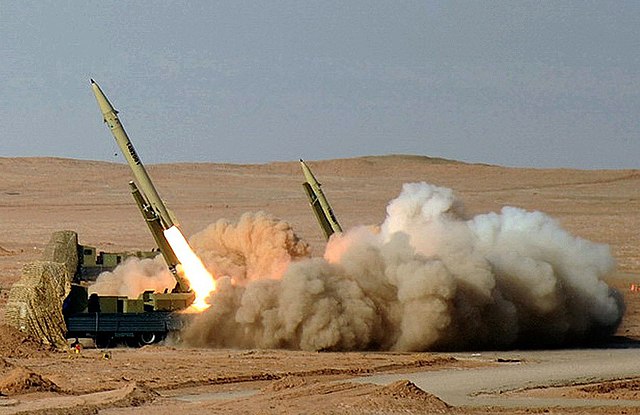
Photo: Great Prophet VII Maneuvers Iran, Creative Common License

Earlier this month, Saudi Arabia charged Iran with an “act of war”.

Saudi Arabia and Iran have been engaged in suppressed aggression and hostility for decades. After Yemen rebels known as Houthis overthrew the government in 2015, Saudi forces began an attack against the Houthi forces to restore the internationally recognized government. Yemen has since been caught in the midst of conflict that has killed over ten thousand civilians. Saudi air strikes have been the leading cause of civilian casualties. Iran has openly expressed its support for the Houthi, but it has never claimed to provide resources or to lead the rebel group.

On November 4th, a missile was fired from Yemen towards Riyadh, the capital of Saudi Arabia, and intercepted over the city’s airport. The Houthi claim the missile attack was retaliation for a Saudi attack that killed twenty-six people. Saudi Arabia and the United States have since accused Iran of providing missiles to Yemen rebels, one of which was used in the attack on Riyadh. Although Saudi Arabia and the United States have previously accused Iran of supporting the Houthis, there has never been direct proof of the allegation.  

Saudi Arabia’s declaration that Iran has engaged in an act of war is a bold one and a particularly foreboding one, following the years of hostility between the two nations. This begs the question —When does an act of aggression amount to an “act of war”?

The US Code defines “act of war” as “any act occurring in the course of (a) declared war; (b) armed conflict, whether or not war has been declared, between two or more nations; or (c) armed conflict between military forces of any origin”.

War can only occur between states. A conflict between a state and a non-state actor, such as a rebel group or terrorist organization, cannot constitute war. The exception is when the non-state actor is sponsored by a state. Saudi Arabia will need to prove that the Houthis were sponsored by Iran in order to properly allege that the missile attack was an act of war by Iran.

The United Nations Charter does not address “act of war”, but it does address the use of force. Article 2(4) requires members to refrain from “the threat or use of force against the territorial integrity or political independence of any state”. The missile attack clearly constitutes a use of force; however, Saudi Arabia must still show that it was a use of force by a member state.

There is no settled definition for “act of war”. The term has evolved to become more political than legal, with many believing that an “act of war” is simply any act that a state uses to justify a declaration of war.
In a statement responding to the attack, Saudi Arabia asserted that “the Kingdom reserves its right to respond to Iran in the appropriate time and manner”. What Saudi Arabia considers to be an appropriate response remains to be seen. 
By April Kent

On April 15, Adam Szubin, the acting undersecretary of Treasury for terrorism and financial intelligence, warned against overusing sanctions in an address at the Center for a New American Security. He cautioned that “Even when sanctions do work, they can come with negative side effects,” such as retaliation from foreign governments, strain on diplomatic relations, and dampening commercial activity. Szubin’s concerns come as a reaction to the introduction of a bill in early April by Senators Mark Kirk and Marco Rubio that would keep Iran from gaining even indirect access to the U.S. financial system or using U.S. dollars in business transactions. The issue has become particularly important in this U.S. election year, as the remaining Republican presidential candidates have all vowed to tear up or back away from the nuclear deal, which Obama administration officials say would be calamitous.

By William Stroupe

Investigations of the vast trove of leaked documents from Panamanian law firm Mossack Fonseca have revealed widespread assistance in clients’ efforts to evade sanctions. The firm registers offshore corporations under its own name, keeping owners’ names out of publicly reported information. After the imposition of sanctions, the firm continued to work for entities and individuals with ties to some of the world’s most oppressive regimes. In addition to sanctioned entities in Zimbabwe and Iran, this includes a corporation owned by North Korean officials under U.S. sanctions for activities related to nuclear proliferation, six owned by embattled Syrian dictator Bashar Al-Assad’s billionaire cousin, and another owned by a close friend of Vladimir Putin and thought to be operated on the Russian autocrat’s behalf.  Investigation into the cache of over 11.5 million documents is ongoing.
By Alex Yeager

The process back to normalized trade between Iran and the western world has been slow, but major companies are beginning to test the waters. Oil exporters, in particular, have begun to explore the untapped potential in the large Middle-Eastern nation. Both the United States and the European Union have lifted sanctions related to Iran’s nuclear program, but many grey areas remain in determining what constitutes legal trade and commerce between the two nations.
By Olga Symeonoglou

On February 18, the American Society of International Law, George Washington University Law School, and the American Bar Association’s Section of International Law will host a webcast with the U.S. Department of State Office of the Legal Adviser. The program – “Live from L: The Iran Nuclear Deal” – will feature speakers from the Office of the Legal Adviser, including Principal Deputy Legal Adviser Mary McLeod. The program is free, but registration is required to attend in person or to listen to the webcast.   


The Iran Nuclear Deal, which was reached on July 14, 2015, was implemented on January 16. The deal reduces sanctions on Iran in exchange for a reduction of nuclear capabilities.
By April Kent

At the beginning of October, Iranian Oil Minister Rokneddin Javadi invited foreign investors to help develop its oil fields and improve pipeline and refinery infrastructure in the country. This past Friday, Reuters has reported that the U.S. State Department recently cabled a “demarche” to embassies around the world to reiterate that sanctions on Iran are still in place and will not be lifted until the International Atomic Energy Agency verifies compliance with the terms of the Iran Nuclear Deal. The U.S. wants to prevent a rush by Western companies to invest in Iran’s oil industry and other businesses. European oil executives from Royal Dutch Shell and Eni have already been sending small teams to Iran to meet with Iran’s oil minister about potential opportunities. American companies, on the other hand, face tighter restrictions: the Iran Nuclear Deal does not include easing many of the sanctions that have prevented U.S. companies themselves from doing business in Iran.
By Alex Yeager

While still a hot button political issue, the Iran Nuclear Deal looks poised to pave the way for the re-opening of trade between the nation and other large developed economies. Experts have indicated that Iran likely has the most to gain from the potential removal of sanctions by the United States and Europe. Trade between the U.S. and Iran is not expected to jump significantly, however there is speculative that deal may revive Europe’s historically large trade relationship with the Middle-Eastern nation.
By April Kent

This past Thursday, Senate Democrats blocked a resolution that would have disapproved the Iran Deal, effectively ensuring that it will go into effect without a showdown between Congress and the President. The Iran deal has been offered as proof that economic sanctions can be used effectively to change the behavior of repressive regimes while avoiding military action. But the question of what to do next remains a challenge. The United States agreed to lift many of the sanctions that have blocked Iran’s integration into the world economy. However, President Obama promised to maintain sanctions to punish Iran for terrorism and human rights abuses. One expert explains: “There is a tension between ensuring that Iran has an economic incentive to keep the agreement with its nuclear constraints and ensuring companies keep doing business with Iran, while at the same time policing Iran’s support for terrorism with sanctions.”
By Catherine Kent

Reuters reported on April 6, 2015 that Russia does not fear that the preliminary deal with Iran on Tehran’s nuclear program will lead to a new arms race. According to Russian Foreign Minister Sergei Lavrov, the delay in the deal-making is the fault of the United States and Europe. The deal, reached –between Iran and the U.S., Britain, France, Germany, China, and Russia–involves curbing Tehran’s nuclear research for at least 10 years and slowly lifting the Western sanctions. Lavrov commented that lifting these sanctions will help Russia, as Iran can now pay in full for deals with Russia’s nuclear agency.
By Catherine Kent

Reuters reported on April 6, 2015 that lawyer Gary Osen filed an amended complaint in federal district court in Brooklyn against six Western banks for conspiring with Iranian banks to circumvent U.S. sanctions on Iran. The plaintiffs, over 200 former U.S. soldiers and their families, claim to have been victims of Iran-sponsored attacks during the Iraq war. The six Western banks have allegedly masked wiring of $60 million worth in transactions with Iranian banks designated by the US to be terrorist organizations.
By Catherine Kent

On April 6, 2015, The National reported that due to a preliminary deal last week between the United States and Iran, oil prices have bounced back. The world benchmark North Sea Brent crude oil futures are trading up 2.7% from the close of the previous day, at $56.47.  While a deal was reached, it was not the final deal, and both parties also agree that this is just the first step down a long road. The plan is for the sanctions to be lifted slowly in congruence with Iran’s meeting certain milestones within the agreement. This bounce-back in oil prices might be short-lived as, Iran has 700,000 barrels per day of spare capacity that it has not been able to sell since the sanctions were put in place.
By Stephen Levy

The U.S. Senate voted 100-0 on March 26th for a bill amendment to ensure sanctions could be applied to Iran should the country violate any upcoming agreement. The vote represented a rare moment of unanimity after weeks of divisive rhetoric on the talks with Iran. The amendment, attached to the Senate’s budget bill, was written by Senator Mark Kirk (R-IL), and would set aside the money needed to impose sanctions if Iran failed to comply with the ongoing Joint Plan or a future permanent agreement with the P5+1. The amendment was non-binding, and the budget passed by the Senate serves as a guide rather than a requirement. However, the bill might indicate support for future Congressional action against Iran, should the P5+1 fail to reach an agreement with Iran, or Congress prove skeptical about the provisions designed to ensure Iran complies.
By Kristen E. McCannon

The United Nations announced on March 18 that the U.N. Office on Drugs and Crime would move forward on a plan to fund an anti-drug trafficking program in Iran, despite objections from some human rights observers. The plan would provide millions of dollars to Iran’s counter-narcotics trafficking program, which pursues the death penalty for some convicted drug offenders.

Almost half of the 753 prisoners that were executed in Iran last year were executed for drug-related offenses. Drug executions in Iran are increasing. The rate of execution for drugs offenses has quadrupled over the previous three years, to an average of roughly five hundred executions per year.

Many Western human rights organizations, particularly those in Europe, have opposed the United Nations plan to support Iran’s anti-trafficking program. Maya Foa, an anti-death penalty campaigner for Reprieve, noted “A lion’s share of this funding is set to come from European governments, who…condemn the death penalty while funding drug raids where those caught are hanged from cranes in public.” A number of governments, including Britain and Denmark, have recognized the moral implications and have publically withdrawn their support for the plan. 
By Jenny Park

U.S. federal and state authorities accused Commerzbank of dealing with Iranian companies blacklisted by the U.S. and of enabling a Japanese company to carry out accounting fraud. Commerzbank agreed to pay $1.45 billion, to admit to its conduct in a statement of facts, and to dismiss employees involved in the investigations. Although Commerzbank avoided an indictment, prosecutors can revoke the settlement if the bank misbehaves in the future. The outcome clashes with the relatively lax consequences of American banks accused of manipulating foreign currencies and other wrongdoings in foreign countries.

Read more in the Dealbook.
By Catherine Kent

Talks are ongoing between Iran and the United States, France, Germany, Russia, China, and Britain. In exchange for relief from sanctions that have seriously damaged its economy, Iran will take steps to curtail its nuclear program. U.S. Secretary of State John Kerry and Iranian Minister of Foreign Affairs Mohammad Javad Zarif are set to meet again on March 15 in Switzerland to continue their attempt to reach an agreement over future of Irans nuclear development. Though Kerrys last met with Zarif, on Monday, March 2, nothing has yet been agreed upon. Iran, on the other hand, denies seeking atomic weapons, maintaining that its nuclear energy program is strictly peaceful. “The imposed sanctions on Iran are cruel and illegal … lifting all the sanctions is the only way to reach a nuclear deal,” said Ali Shamkhani, secretary of Irans Supreme National Security Council. Bilateral and trilateral meetings with the P5+ countries will follow these one-on-ones, and the countries hope to reach a final deal by June 2015.
By Jenny Park

On March 3, 2015, the Israeli Prime Minister, Benjamin Netanyahu, addressed Congress regarding the Iranian nuclear crisis. Netanyahu called for Iran to completely abandon its nuclear program and for the US and Europe to impose tougher sanctions against Iran. Subsequently, Republican senators warned Iran that any international deal on the Iranian nuclear program could be revoked when President Obama leaves the office. This strong rhetoric attempts to undermine the current negotiations among Iran and the six world powers, scheduled for preliminary agreement by the end of March and to be finalized by the end of June.

Iran is a signatory to the Non-Proliferation Treaty (NPT), which requires all signatory states to use nuclear material, if any, only for peaceful purposes. As part of this commitment, the signatory states must work with the International Atomic Energy Agency (IAEA), an independent branch of the UN that works to ensure that states do not use nuclear material for military purposes. After a signatory state implements safeguards and submits a declaration of the state’s nuclear materials and facilities to the IAEA, the IAEA verifies its implementation and its continuing compliance. 
By Stephen Levy 

The Joint Plan of Action, the interim agreement made between the five permanent members of the UN Security Council (UNSC) and Germany (P5+1) and Iran in 2013 set the final deadline on a permanent agreement on Iran’s nuclear program on November 24, 2014. On that date, however, the two sides were unable to reach an agreement, and extended the deadline to March 24, 2015.

The continuation of negotiations has angered two influential parties with additional political motives. First is Israeli Prime Minister Benyamin Netanyahu, whose party is clinging to a narrow lead in the polls for a March Knesset election primarily due to Netanyahu’s national security credentials. Netanyahu has consistently opposed striking a deal with Iran, and warned the West that only continued sanctions would end the crisis. U.S. Republicans in Congress, joined by multiple Democrats, have also proposed additional sanctions against Iran should it fail to negotiate in good faith. House Speaker John Boehner invited Netanyahu to give a speech in front of a Joint Session of Congress, setting off fierce discussions on whether the President can meet with leaders up for election, whether Congress and the White House should coordinate on speeches by foreign diplomats to Congress, and the relationship between Israel and Iran itself.
By Catherine Kent

NITC, Iran’s main oil tanker firm, has been on and off the EU’s blacklist.  With the EU to put NITC back unto the blacklist, NITC sought an urgent injunction on Friday to compel Britain to veto against EU decision. The High Court denied NITC the injunction on Monday, finding merit with Britain’s arguments that a British veto would detract from London’s reliability on the Iranian nuclear issue.
By Stephen Levy

Iran has been selling crude oil furtively to dodge U.S. and EU sanctions, Reuters reports, as the U.S. considers more sanctions. In alliance with Emirati companies, Iran has been disguising its crude oil by mixing it with other fuels, distributing at distant locations, and even using false documents. In a sign of the relative effectiveness of the sanctions, however, few large companies and traders have participated in those efforts, and Iran has had to sell the fuel at a significant discount. The U.S. has confirmed that it is investigating with the Emirati government, but it remains to be seen if any traders will be sanctioned. The sanctions have served better as a deterrent than a punishment, and if the U.S. views the negotiations as close to ending, it might consider moderating its response.